
 Gucchi:
programming help
 Gucchi:
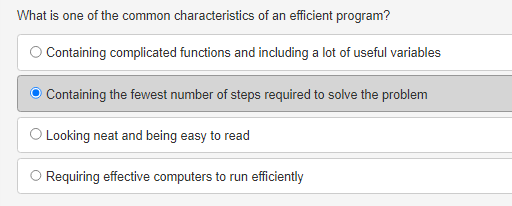
am i right with B here?
 whyjustwhy:
1, 2, 3
 Amorist:
I believe the correct answer is b) containing the fewest number of steps required to solve the problem. An efficient program focuses on optimizing performance by minimizing the steps needed to achieve a solution, which directly affects execution time and resource usage. Option a, which suggests that a program should contain complicated functions and many variables, is not correct because complexity can actually hinder efficiency. More variables and complicated functions can lead to longer execution times and make debugging more difficult, ultimately detracting from overall program performance. While neatness and readability (option c) are important for maintainability, they don't directly enhance efficiency.
 MAGABACK:
ok I think he got it. I mean, B makes sense
 Alexis1415:
Definitely B
whyjustwhy:
 sllo:
sllo:
Yes
MAGABACK:
Yup I think it is safe 2 say b
 toga:
toga:
Join our real-time social learning platform and learn together with your friends!
 VERNEISH:
Two objects are moving along separate linear paths where each path is described by position, d, and time, t.
VERNEISH:
Two objects are moving along separate linear paths where each path is described by position, d, and time, t.

 Maci:
what are the best stock apps for people who want to start investing?
Maci:
what are the best stock apps for people who want to start investing?
 Twaylor:
genuienly how do i get better self control i keep watcing youtube and theres this
Twaylor:
genuienly how do i get better self control i keep watcing youtube and theres this
 IzzyCookie:
|dw:1792074056138:dw| Uhm, I don't know where to ask this, but I'm in college welding at my community college, and I need help learning vertical welding for
IzzyCookie:
|dw:1792074056138:dw| Uhm, I don't know where to ask this, but I'm in college welding at my community college, and I need help learning vertical welding for

 thehearken:
not sure if this is considered spam, im sorry if it is, but does anyone have tips
thehearken:
not sure if this is considered spam, im sorry if it is, but does anyone have tips